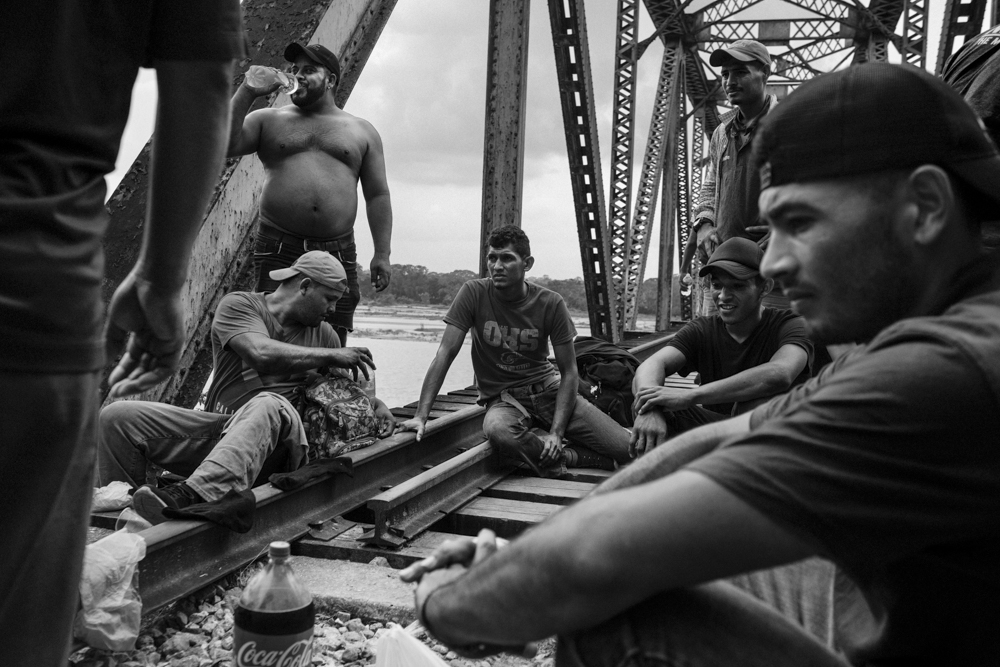
Path away


Share on social media
  • Photographer
    Nicolo Filippo Rosso
  • Prize
    Honorable Mention
  • Jury Top 5 Selection

    This is an intimate, well-done story that documents refugees journey from South America to Mexico and the US. Could have used one less "river crossing" photo but otherwise, it's a very good set of images.

  • Company/Studios
    Freelance
  • Date of Photograph
    2021
  • Technical Info
    Canon EOS 5D Maek IV; Canon EOS R5
  • Socials
  • Website

In Latin America, lack of job opportunities, access to education, political corruption, and impunity have persisted for generations fueling circles of violence and displacement that are both the symptom and the cause of disrupted societies. For four years, I have traveled along migration routes documenting the journey of refugees and migrants from Venezuela to Colombia and from Central America to Mexico and the United States. This series is the most recent chapter of the project that I called Exodus, and the result of 8 months of travel, in 2021, from Central America to the United States.

  • Biography
    Nicoló Filippo Rosso (b. 1985) is an Italian documentary photographer based in Colombia. He graduated with a degree in Literature at the Universitá Degli Studi Di Torino, in Italy. Since 2016, Nicoló has been documenting the impact of the exploitation of coal on the land and the people of Colombia’s La Guajira peninsula. This work has been exhibited worldwide, and it has appeared in numerous magazines and newspapers’ publications. Currently, he is mostly dedicated to documenting the migration of Venezuelans who cross the border with Colombia heading to other Latin-American countries.
  • Awards
    - Short Story Award, Festival della Fotografia Etica, finalist 2020 - Getty Images Reportage Grant, winner, 2020 - Honorable mention for ZEKE Award for Documentary Photography, 2020 - Finalist at Kolga Tbilisi Photo Festival in Tbilisi (Georgia), 2020 - World Press Photo, 3º prize in Contemporary Issues Stories, 2020 - Personal exhibition at Maison du développement durable, in Montreal (Canada), 2019 - Finalist at Prix Lucas Dolega (France), 2019 - Personal exhibition at UNHCR, the UN Refugee Agency, in Washington D.C. (US), 2019 - Finalist at Alexia Grant (US), 2019 - Exhibition at ZOOM Photo Festival, Saguenay (Canada), 2019 - Photographer nominated at 6x6 World Press Global Talent Program, 2019 - Selected photographer at Dart Center for Journalism and Trauma, New York (US), 2019 - Winner at Humane Nature, Zoom Photo Festival, Saguenay (Canada), 2019 - Exhibition at Indian Photography Festival, Hydera- bad (India), 2019 - Honorable mention at Moscow Internation Photo Award (Russia), 2019 - Winner Professional Photography Award at Harvard Review of Latin America (US), 2018 - Photographer nominated at World Press Masterclass, 2018 - Personal exhibition at Melaka Art Gallery in Bogotá (Colombia), 2018 - Eddie Adams Workshop, 2017 - Personal exhibition at Uniminuto University (Colombia), 2017 - Personal exhibition at the University of Antioquia (Co- Colombia), 2017 - Personal exhibition at Valenzuela-Klenner Gallery in Bogotá (Colombia), 2017 - Finalist at Kolga Tbilisi Photo Festival in Tbilisi (Georgia), 2016 - IPA Awards, Honorable Mention, 2016 - Personal exhibition at Valenzuela-Klenner Gallery in Bogotá (Colombia), 2015 - Finalist at National Geographic Contest “La Fotografia in Viaggio” (Italy), 2013

Story

In 2021, after hurricanes Eta and Iota hit Central America, I traveled to Honduras. There, flooding and mudslides had affected 4.5 million victims, fueling one of the most significant migrations towards the United States of the last decade. This recent wave came on the heels of years of other migrations from Central America to the U.S., often fueled by political instability and uncontrolled gang violence.
Expanding an already existing body of work, I have traveled for eight months in a row between Honduras, Guatemala, Mexico, and the United States.
Following migrants directed to the north from different countries, I have seen countless stories of loss and separation merging into a single narrative. After three years documenting the Venezuelan migration to Colombia, I was surprised to see so many Venezuelan migrants walking along the same Mexican routes people from Honduras and Guatemala traverse to enter the United States in Texas. I have documented their journey keeping in mind the diversity of reasons that push each population to emigrate, but with a sense that human mobility defines the continent’s societies. Decades of civil war, endemic poverty, or violence in Latin America make it hard for migrants to find better conditions than those fleeing. As the unstable environment doesn’t change at their destination, many continue to move, often on foot, hoping to find a place where they might start a new chapter of their lives in the United States. Some never reach their destination, as for 13 migrants from Guatemala allegedly killed by the Mexican police while they were trying to cross into the United States, in the Tamaulipas state. In March, I traveled to Guatemala to document their funeral after the bodies were repatriated to their village.
Continuing this project, It became clear that I would have to expand my investigation to the entire continent to understand the complexity of this unprecedented exodus.

You can create multiple entries, and pay for them at the same time.
Just go to your History, and select multiple entries that you would like to pay for.